
The Natural Law Guide
Ayurveda for Stress and Calm: Why Relaxing Harder Does Not Work
Photo: Marcus Aurelius / Pexels (Pexels License)
Most stress advice asks you to relax harder. A bath, a glass of wine, an evening on the sofa with your phone. Then the next day arrives, built exactly like the last one, and winds you up all over again.
Ayurveda for stress starts somewhere else. It reads stress as a pattern you repeat every day, not a mood you need to escape. It asks which kind of stress you run (Vata worry, Pitta frustration or Kapha shutdown), what is feeding your mind from morning to night, and whether your day has a rhythm your nervous system can lean on. Then it gives you small daily practices: slow breath, warm oil, regular meals, fewer inputs and an evening that actually ends.
A note before anything else. Ayurveda is a traditional system, and this guide is education, not medical care. If worry, low mood or panic is running your life, see your healthcare provider. The section near the end on where Ayurveda stops is not a footnote. Read it.
You cannot relax your way out of a pattern you repeat every day
Relaxing is what you do after the damage. It is recovery. Recovery is fine, but it cannot keep up with a day designed to wind you up.
Look at what an ordinary day asks of you. You wake to a phone. You eat standing up, or not at all. You answer messages while doing something else. You look after everyone. At ten at night you finally sit down and scroll, because it is the only time that feels like yours.
None of that is dramatic. That is the problem. It repeats.
Ayurveda does not ask how to manage stress. It asks why the strain keeps arising. That is also why a holiday cannot fix it on its own. You come home, and the shape of the day has not changed.
So the Ayurvedic answer is not a bigger reward at the end of the day. It is a different shape to the day itself.
How Ayurveda reads stress
Ayurveda does not see stress as weakness. It reads it as misalignment: effort that has outrun rhythm.
The tradition has a name for the root of it. Prajnaparadha, usually translated as the “mistake of the intellect.” It does not mean you are not clever. It means the moment you know better and do otherwise. You know you are tired, and you stay up. You feel the no, and you say yes. You feel your clarity going, and you push on anyway.
In Ayurvedic terms, doing that day after day disturbs the doshas and drains ojas, the reserve of vitality that keeps you steady under pressure. Our guide to energy and burnout covers the fatigue side of that story. This guide is about the mind.
Two things follow from this view, and both are useful.
- Stress is information. It shows up early as small signals: a shorter fuse, a busier mind at night, meals you no longer taste. Caught there, it is much easier to answer.
- The fix is mostly boring. If the cause is a daily pattern, the answer is a daily pattern too. Not a retreat. A routine.
Three signatures: Vata worry, Pitta frustration, Kapha shutdown
Stress does not look the same in everyone. Ayurveda describes three signatures, one for each dosha. Each dosha shapes your emotional patterns in its own way, and what settles one can aggravate another.
Vata stress is worry. Vata is air and space: light, quick, always moving. Under pressure it scatters. You may notice a racing mind, conversations rehearsed in your head, trouble settling at night, forgotten meals, sensitivity to noise and overstimulation and that tired but wired feeling. Vata needs grounding: warmth, regular meals, routine and slow breath.
Pitta stress is frustration. Pitta is fire. Under pressure it overheats. You may notice irritability, a short fuse, perfectionism, criticism of yourself and everyone around you, fiery emotions that flare fast, and working harder exactly when you should stop. Pitta needs cooling and softening: less competition, time near water or green space, and permission to do fewer things well.
Kapha stress is shutdown. Kapha is earth and water: steady and slow. Under pressure it withdraws. You may notice heaviness, sleeping more and waking unrefreshed, reaching for comfort food, putting things off, going quiet and pulling away from people. It is easy to miss, because from the outside it can look like calm. Kapha needs gentle stimulation: movement, a little challenge, company and lighter food.
Two cautions. Your constitution and your current state can differ, so a natural Kapha can run a Vata kind of stress for a season. And most people lean on more than one. Read all three and notice which describes your worst weeks. If you are not sure where you start, take the free dosha quiz, and Understanding Your Dosha goes deeper.
Sattva, rajas and tamas: the mind’s three states
The doshas describe your constitution. The gunas describe the state of your mind, and that shifts through the day.
- Sattva is clarity. Steady, awake, kind, able to see what matters. It is the state Ayurveda aims for.
- Rajas is activity. You need it to get things done. In excess it becomes agitation, restlessness and the feeling that you cannot stop.
- Tamas is inertia. You need it to rest. In excess it becomes dullness, heaviness and numbing out.
Here is the part that explains the title. In Ayurvedic terms, most of what we call relaxing is a swing from rajas to tamas. You rush all day, then collapse in front of a screen with a drink or a snack. That is not calm. It is the other end of the same seesaw, and the next morning you need the rush again just to get moving.
Calm, in Ayurvedic terms, is sattva. Sattva does not arise through force. It grows from regular nourishment, enough rest, honest limits and gentle consistency.
The tradition is practical about what feeds each state:
- Feeds rajas: rushing, multitasking, constant notifications, stimulants, arguments, eating on the go.
- Feeds tamas: stale or very heavy food late at night, oversleeping, long stretches of passive screen time, isolation.
- Feeds sattva: fresh, simple, warm food at regular times, a daily rhythm that follows the sun, slow breath, quiet, and doing one thing at a time.
You do not need to become a saint. You only need a little more of the third list than you have now.
Breath first: nadi shodhana and bhramari
Ayurveda sees the breath (prana) as the bridge between body and mind. When the breath is ragged, the mind follows. When the breath slows, the mind has something to settle on.
Modern work points in a similar direction. A 2018 systematic review by Andrea Zaccaro and colleagues gathered studies of slow breathing, under ten breaths a minute, in healthy adults. Across those studies, slow breathing went along with higher heart rate variability, which the authors read as a sign of the body’s rest and digest system at work, and people reported feeling more relaxed and less anxious. The limits matter. Only fifteen studies met the review’s criteria. All were in healthy volunteers, and anyone over 65 was left out. The studies were too different to pool into one result, and the authors call for longer-term research. So it tells you slow breathing tends to settle the system in the moment, not that any one technique fixes anything.
Both of the breaths below are done slowly. Neither was tested by name in that review, so take the research as a pointer, not proof.
Nadi shodhana (alternate nostril breathing)
This is the classic Vata settler and a good daily base for anyone. It is the first practice we reach for with a busy mind.
- Sit upright and let your shoulders drop. Rest your left hand in your lap.
- Close your right nostril with your right thumb. Breathe in slowly through the left.
- Close the left nostril with your ring finger and lift the thumb. Breathe out slowly through the right.
- Breathe in through the right. Close it, open the left, and breathe out through the left. That is one round.
Start with five rounds and build toward five minutes. Keep the breath smooth and quiet. Do not hold it, and do not stretch it longer than feels easy. If your nose is blocked, breathe normally and imagine the breath moving from side to side.
Bhramari (humming bee breath)
The long humming out-breath slows you down almost by default, which is why it suits evenings and heated moments. Ayurveda considers it helpful for every dosha, and humming is one of the simplest sound practices in the tradition.
- Sit upright with your mouth closed and your jaw soft.
- Breathe in through your nose.
- Breathe out slowly while making a low, steady hum, like a bee. Feel the vibration in your face and chest.
- For a more inward version, use your thumbs to press the small flap at the front of each ear gently closed while you hum.
Five to seven rounds is plenty. Keep the hum low and easy, not loud.
Cautions for both
- Stop if you feel light-headed, dizzy or more anxious, and go back to normal breathing.
- If you are pregnant, or have a heart or lung condition, ask your provider before starting a breathing practice.
- Leave the ears uncovered if you have ear pain or any ear problem.
- Never do breathing practices while driving.
- Chest pain is not something to breathe through. Stop and get medical help.
The body calms the mind
Ayurveda works from the outside in as much as from the inside out. A frayed nervous system is often easier to reach through the body than through telling yourself to calm down.
Warm oil massage (abhyanga)
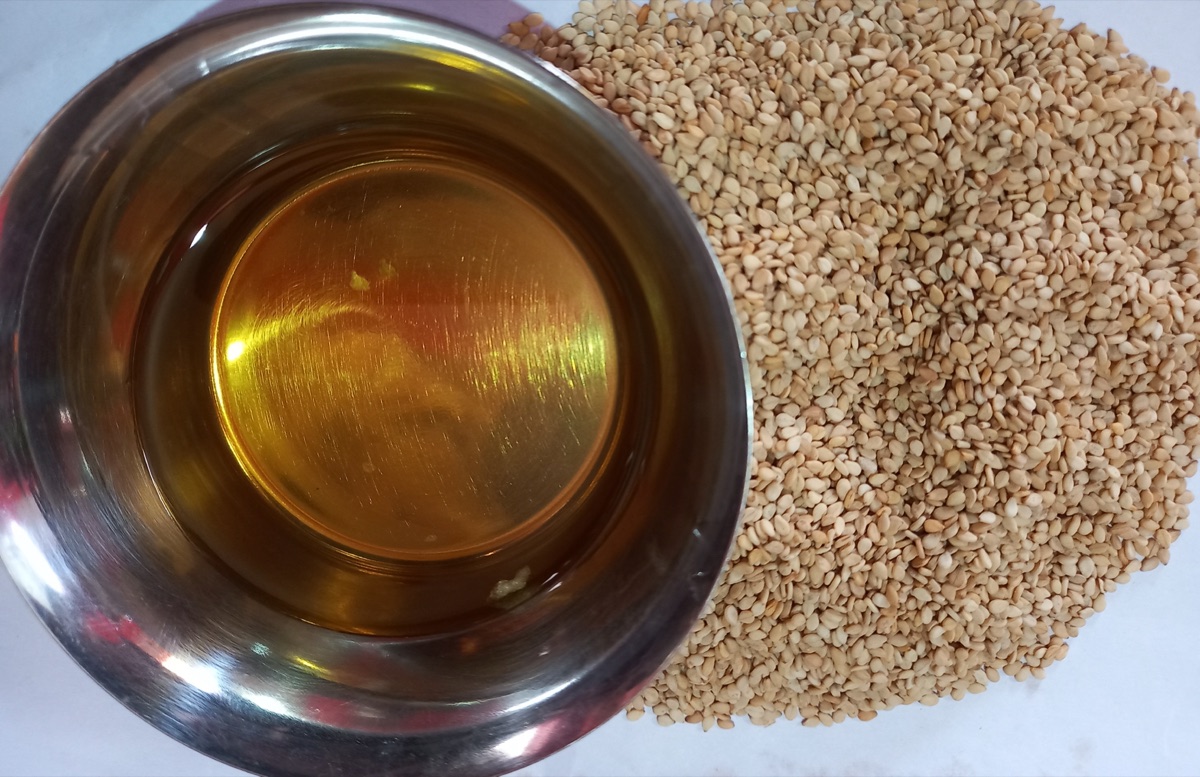
Abhyanga is self-massage with warm oil, and Ayurveda values it above all for grounding Vata. Warm a little sesame oil (coconut if you run hot), and work it in with long strokes on the arms and legs and circles over the joints. Leave it on for a few minutes, then shower. Our post on abhyanga walks through it. If a full massage is too much on a weeknight, do your feet at bedtime and nothing else.
Warm meals at regular times
In Ayurvedic terms, skipped meals and eating on the move unsettle Vata, and an unsettled Vata means an unsettled mind. The fix is plain: three warm meals at roughly the same times each day, with lunch as the main one. Sit down. Put the screen away. Eat slowly enough to taste the food. For the digestion side of this, see our guide to Ayurvedic gut health.

An evening that actually ends
This is often the hardest part. The day never finishes. It trails off into dishes, messages and one more thing, and then you lie in bed with your mind still at work.
Ayurveda says the evening should close. Evening rituals are about release, and they work best with a clear ending:
- Pick a time when the day’s work stops, and tell the people you live with.
- Dim the lights and turn off screens thirty to sixty minutes before bed.
- Write down what is on your mind for tomorrow, so your head does not have to keep holding it.
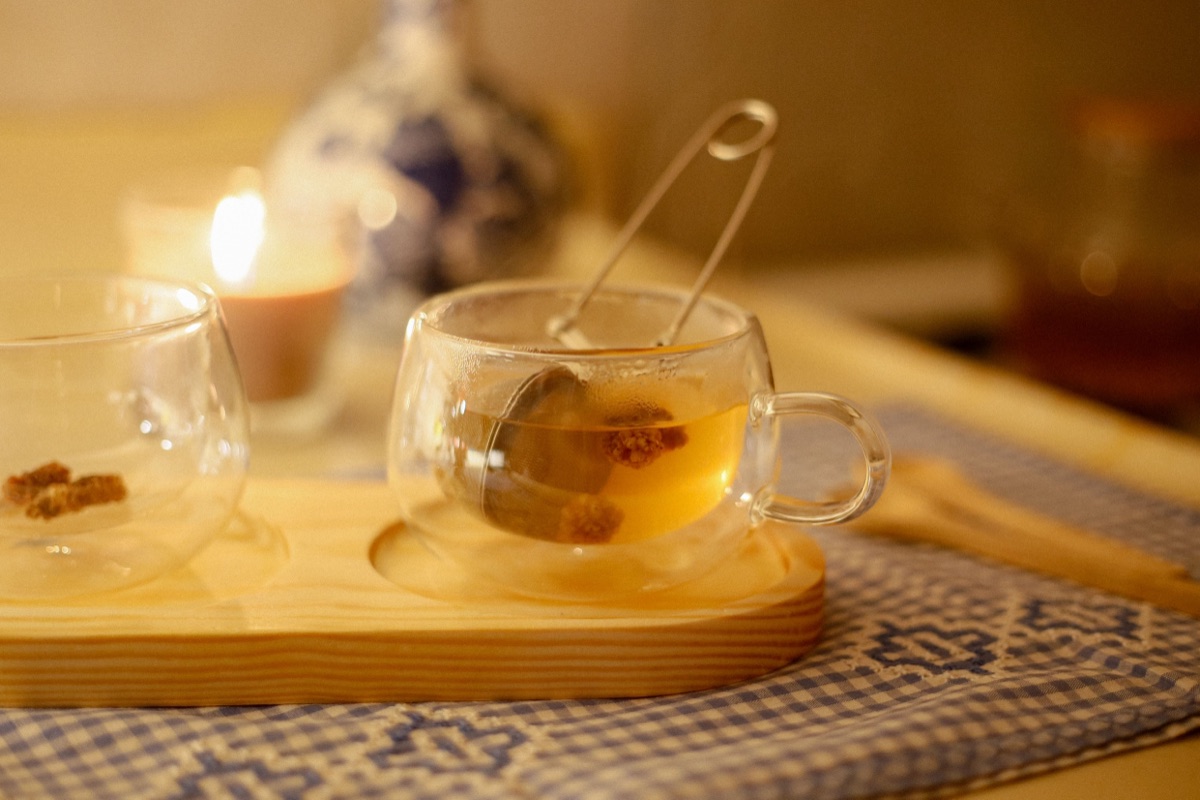
- Have a warm drink without caffeine, do a few rounds of bhramari, and rub warm oil into your feet.
Our Ayurvedic sleep guide goes further into the night itself.
Fewer inputs: screens, news and the always-on day
Ayurveda would read a smartphone as a Vata machine. Every ping is a small movement of attention, and a day made of them leaves the mind scattered. Constant digital input keeps the nervous system on alert, and the tradition’s answer is boundaries for the senses.
Two pieces of modern work are worth knowing, with their limits.
Screens at night. In a 2015 laboratory study led by Anne-Marie Chang, twelve healthy young adults read for about four hours before bed on five evenings in a row on a light-emitting tablet, and on five other evenings from printed books. On the tablet nights they took longer to fall asleep, released less melatonin in the evening, had their body clocks shifted later and were less alert the next morning. It was small, the volunteers averaged their mid-twenties rather than midlife, and the room was kept very dim while the tablet stayed at full brightness for about four hours. But it points the way Ayurveda does: bright screens late at night work against rest.
The news. After the 2013 Boston Marathon bombings, E. Alison Holman and colleagues surveyed several thousand Americans. Taking in six or more hours a day of bombing coverage in the week after was linked to more acute stress symptoms than being directly exposed, which the survey counted as being at or near the site or having someone close who was. It was a survey, so it shows a link, not a cause. The authors think the link probably runs both ways, since the most distressed people are likely to seek out more coverage. And it was about a traumatic event, not ordinary news. Still, it is a good reason to watch how much coverage you take in when something frightening happens.
What to do with that:
- Turn off notifications for everything except the people who genuinely need to reach you.
- Check the news once or twice a day at set times. Not first thing, and not in bed.
- Do one thing at a time. Ayurveda calls focused attention ekagrata. Protecting your attention is a practice, not a personality trait.
- Take anchor breaths. Between tasks, take a short pause of stillness and three slow breaths before you start the next thing.
Where Ayurveda stops
Ayurveda is good at daily patterns. It is not emergency care, and it does not replace a diagnosis. Please see your healthcare provider if:
- Worry, low mood or a loss of interest in things has been there most days for a couple of weeks or more.
- Stress is getting in the way of your work, your relationships or looking after yourself.
- You have sudden episodes of a pounding heart, trouble breathing, chest tightness or a sense of dread. Get these checked promptly, because they can have physical causes too.
- Your sleep has been broken for weeks, or you are leaning on alcohol, food or pills to get through the day.
- New physical symptoms have arrived alongside the stress. If it began with other midlife changes, such as around perimenopause, tell your provider that as well.
If you are thinking about harming yourself, do not wait for an appointment. Call your local emergency number, or in the US call or text 988, the Suicide and Crisis Lifeline.
If you already have care, keep it. Do not stop or change a prescribed medicine on your own. The practices in this guide are meant to sit alongside that care, not compete with it.
We have left calming herbs out of this guide on purpose. They are sold hard, they are real substances, and they are not right for everyone. Check with your provider before adding any herb or supplement, especially if you take medication.
A seven-day starting plan
Do not start everything at once. Add one thing a day, and keep what you added.
- Day 1: Find your signature. Read the three stress signatures again, or take the dosha quiz. Write down the two or three signs that show up first for you.
- Day 2: Five minutes of nadi shodhana after you wake, before you pick up your phone.
- Day 3: Fix one meal. Eat lunch sitting down, warm, at the same time as yesterday, with no screen.
- Day 4: Close the evening. Pick an end time for the day and turn screens off thirty minutes before bed.
- Day 5: Add bhramari before bed, five to seven rounds.
- Day 6: Oil your feet with warm sesame oil, or your whole body if you have the time.
- Day 7: Look back. Which practice did you actually keep? Which of your signs showed up less? Keep what helped and let the rest go for now.
Then run the same week again.
Adjust it for your signature. If you run Vata, lean on the warmth and the regular times. If you run Pitta, go easy on yourself about doing the plan perfectly, because a perfect stress plan is the most Pitta project there is. If you run Kapha, add a brisk walk to Day 3 and do your breathing in the morning, not in bed. To fold these practices into the start of your day, see the Ayurvedic morning routine.
The goal is not a perfect routine. It is a day with enough rhythm in it that you no longer need to escape it at night.
Relaxing harder was never the answer. A steadier day is.
Amish
Frequently asked questions
What does Ayurveda say causes stress?
Ayurveda reads stress as misalignment: effort that has outrun rhythm. The tradition calls the root prajnaparadha, the mistake of the intellect, meaning you know what your body and mind need and do otherwise, day after day. Over time that is said to disturb the doshas and push the mind toward agitation or dullness.
How does stress show up for each dosha?
Ayurveda describes three stress signatures. Vata stress looks like worry: a racing mind, restless nights and forgotten meals. Pitta stress looks like frustration: irritability, perfectionism and pushing harder. Kapha stress looks like shutdown: heaviness, oversleeping, comfort eating and withdrawing from people. Most people lean on more than one.
What is the best Ayurvedic breathing practice for stress?
Two slow breaths cover most needs. Nadi shodhana, alternate nostril breathing, makes a steady daily base, especially for Vata worry. Bhramari, the humming bee breath, suits evenings and heated moments. Keep both smooth, never hold the breath, and stop if you feel dizzy. Ask your provider first if you are pregnant or have a heart or lung condition.
What is sattva, and how do you get more of it?
Sattva is the guna of clarity: a mind that is steady, awake and kind. Ayurveda teaches that it grows from fresh, warm food at regular times, enough rest, slow breath, quiet and doing one thing at a time. Rushing and constant input feed rajas, while heavy late food and hours of passive screen time feed tamas.
Can Ayurveda replace therapy or medication for stress?
No. Ayurveda is a traditional system for shaping daily habits, and it works alongside medical care, not instead of it. If worry or low mood has lasted a couple of weeks or more, or stress is disrupting your life, see your healthcare provider, and never stop or change a prescribed medicine on your own.
Keep going with teachers beside you. The Ancient Wisdom Academy is our Ayurveda mentoring academy, with online courses, masterclasses and guided meditations for each dosha.
Explore the Academy