
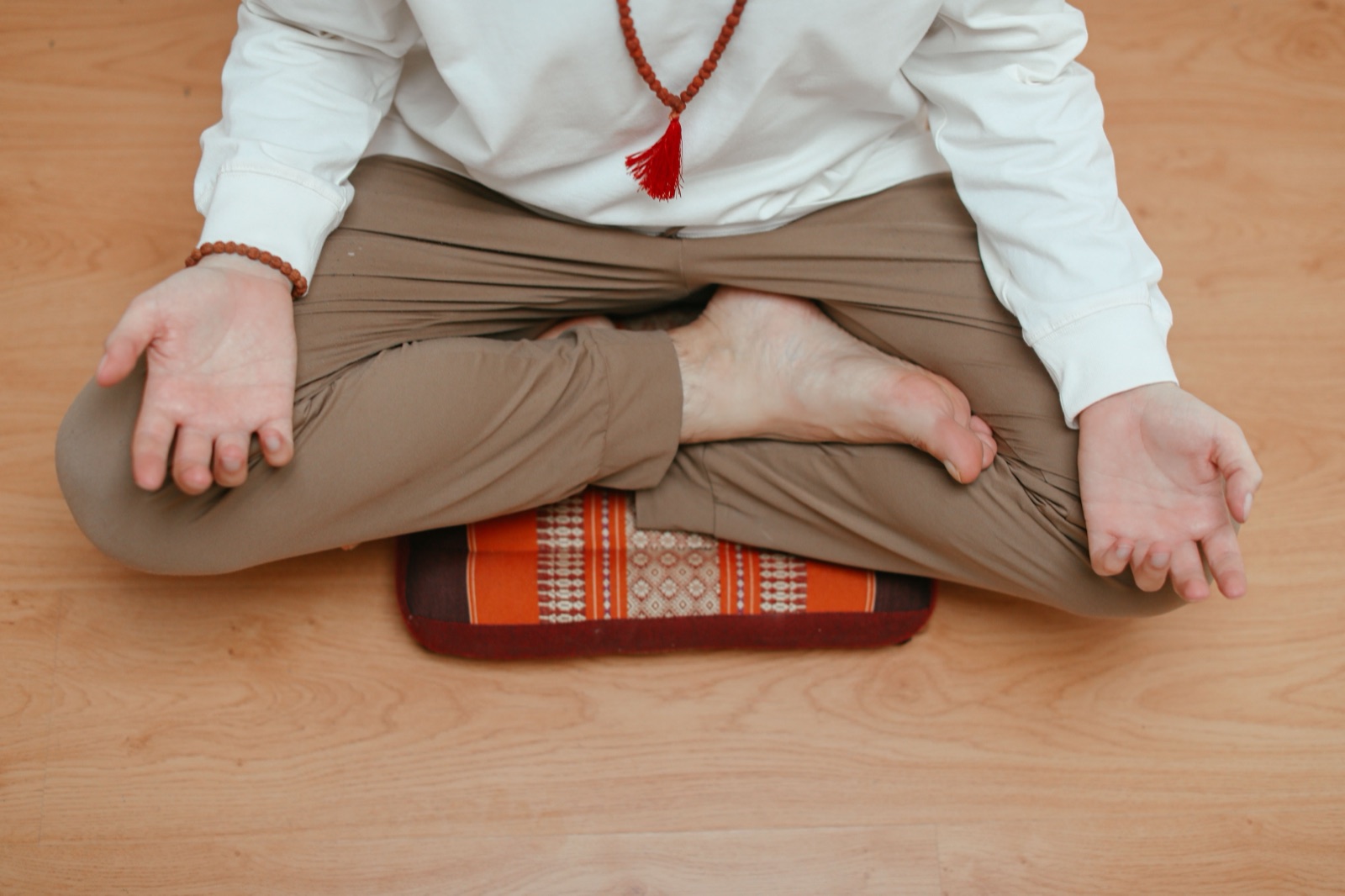
To do bhramari, sit upright, breathe in slowly through your nose, then breathe out through your nose with your lips closed while making a low, steady hum, like a bee. Let the out-breath run longer than the in-breath. That is one round. Do five to seven rounds, then sit quietly for a minute. Closing your ears with your fingers is a common option, not a requirement.
That is the whole practice. No app, no timer, no special cushion.
The simplest calming practice in the tradition is a hum
You have been sold calm as a project. Ayurveda keeps a much smaller tool in the drawer, and the only thing it costs you is a minute of feeling slightly silly.
We have named bhramari on this site before: as the bee breath in our practices for emotional balance, and as the humming breath in the evening ojas repair from Energetic Boundaries. A short paragraph in one, a single line in the other. This page is the full instructions.
What bhramari is, and where it comes from
The name comes from bhramara, the Sanskrit word for a bee. Bhramari is a pranayama, one of the breath practices of yoga, and it is described in older hatha yoga manuals, the Hatha Yoga Pradipika and the Gheranda Samhita. Modern teaching does not always match them. A 2022 paper that compared the old manuals with published research flagged one difference for bhramari in particular: how long the in-breath lasts relative to the out-breath. So if two teachers show you two versions, neither one is automatically wrong.
Our emotional balance post calls bhramari calming whatever your dosha. In Ayurvedic terms it speaks most directly to Vata, though. Vata is air and movement, the dosha that shows up as a racing mind, a restless body and thoughts that will not land. Ayurveda balances a quality with its opposite, and a slow, steady sound is the opposite of scattered. That is the traditional logic.
Setting up: seat, hands and time of day
Your seat. A chair with your feet flat on the floor, or a cushion on the floor. Spine tall, shoulders heavy, lips lightly closed, teeth slightly apart so your jaw is not clenched. A wall behind your back is fine. So is lying down.
Your hands. Pick one of three.
- Hands in your lap. A complete practice on its own.
- Ears closed. Find the small flap of cartilage at the front of each ear, the tragus, and fold it gently over the ear opening with your index fingers or thumbs. Nothing goes into the ear canal.
- The full hand position. One common version: thumbs on the tragus, index fingers resting above the eyebrows, middle fingers laid on the closed eyelids, ring fingers beside the nostrils. Every finger rests. None of them presses, least of all on your eyes.
Time of day. Traditional guidance puts breath practice on an empty stomach, so before a meal or a couple of hours after one. Early morning is the classic slot. Evening is when most people actually reach for it. Both are fine.
The practice, step by step
- Sit, close your eyes, take your hand position and let three or four ordinary breaths go by.
- Breathe in slowly through your nose. Fill up comfortably, not to the top.
- Breathe out slowly through your nose, lips closed, making a low, even "mmmm" on a note you can hold without effort. Keep it quiet. You should feel it more than hear it: a buzz in your lips, your nose, your cheekbones.
- Let the hum run until the breath runs out on its own. Stop before you start squeezing.
- Take a plain, easy breath in. That was one round.
- Do five to seven rounds. Then drop your hands and breathe normally for a minute, eyes closed. That minute counts.
When five rounds feel easy, build toward five minutes.
Common mistakes
Forcing the volume. Louder is not stronger. A loud hum makes you push, and pushing is the opposite of what you sat down for. Hum as if someone in the house is asleep.
Straining the exhale. A long out-breath is the goal. A gasp on the next in-breath means you went too long. Shorten the hum until the inhale comes easily.
Pressing on your ears or eyes. The fingers fold the tragus over, lightly. They do not plug the ear. They never press on the eyeballs. If you see spots or your ears ache, let go.
Giving up on a blocked nose. Breathe in through your mouth and keep the hum for the out-breath.
Judging it halfway through. The first round usually feels awkward. Judge it in the quiet minute afterward, not in the middle. There is a physiological reason for that, below.
What research has and has not measured
This is where most wellness pages oversell. There is real research on bhramari. The studies below are small and short, and almost all of them were done on healthy people, most of them young.
The evidence base is thin. A systematic review in the Journal of Traditional and Complementary Medicine, covering studies up to 2016, found only six studies of bhramari that met its criteria. None was a randomized controlled trial, and the reviewers rated their methodological quality as very low. The studies leaned toward parasympathetic (rest-and-digest) dominance, and the reviewers called for large, properly designed trials.
One session, measured after. In a trial of 60 healthy adolescents in India, randomly split into a bhramari group and a normal-breathing group, the bhramari group had lower heart rate and blood pressure indices after practice than the normal-breathing group. One session, in teenagers, with heart rate taken by feeling the pulse at the wrist. It says nothing about what months of practice would do for you.
During the practice, the picture flips. In a study of 16 healthy young adults doing five minutes of bhramari, heart rate went up while they hummed, and the high-frequency part of heart rate variability, usually read as a sign of rest-and-digest activity, went down. Both returned to normal afterward. The authors said more studies were needed. Judge it after, not during.
The hum may not be the active ingredient. A 2025 pilot with 16 healthy adults compared humming breath with plain slow breathing, five seconds in and five seconds out. Both raised heart rate variability compared with sitting at rest, and there was no difference between them on heart rate variability or on how relaxed people rated themselves. Sitting quietly at rest raised relaxation ratings too. A 2026 follow-up from the same team, with 24 healthy adults, found that humming slowed breathing to around six breaths a minute (estimated from heart-rhythm data, not measured directly), and the authors concluded the effect seemed tied to that slow rhythm rather than to the vibration of the sound. Blocking hearing with noise-cancelling earphones made no measurable difference. In that study, ratings of stress, anxiety and relaxation did not differ between any of the conditions, plain rest included.
The only sleep study we found had no comparison group. In a single-centre study of 42 people diagnosed with COVID-19 but without symptoms, isolating at home, participants practised bhramari online for 20 minutes a day for 15 days, and their questionnaire scores for stress, anxiety and sleep quality improved. There was no comparison group, so there is no way to say how much of that was the breath and how much was time passing.
Put together, that is smaller and more useful than the usual promise. The hum is a built-in timer for a long, slow exhale. No study we found shows bhramari beating other slow breathing, and nothing here makes it a treatment for anything. It is one of the simplest ways to slow down without counting.
Who should skip it or ask a provider first
- Ear trouble. If you have an ear infection, ear pain or recent ear surgery, keep your hands in your lap, or ask your doctor before practising.
- Eye surgery or eye pressure concerns. Keep your fingers off your eyes entirely.
- Dizziness. If you feel lightheaded, stop, open your eyes and breathe normally. If you faint easily, have low blood pressure or take medication for your blood pressure or heart, ask your provider whether slow breath practice suits you.
- Chest pain. Do not breathe through it. Get it checked.
- Pregnancy. Ask whoever is looking after your pregnancy before you start any new breath practice.
- Mood and sleep that are affecting your life. If anxiety, low mood or poor sleep are wearing down your days, bhramari can sit alongside care from your doctor or a therapist. It is not a replacement for it.
And if watching your breath winds you up, open your eyes and hum softly on a normal breath, or leave it for another day.
Fitting it into an evening routine
Ayurveda treats the evening as a slow descent, not a cliff edge. The Night Reset walks through that rhythm: the heavy, drowsy Kapha hours of the evening, and the second wind Ayurveda says arrives if you stay up past them. Bhramari fits at the end of the descent:
- An earlier, lighter dinner.
- Lights down and screens away.
- Sit on the edge of your bed. Five to seven rounds of bhramari. The quiet minute.
- Lie down. Leave the phone where it is.
If you already do other breath work, do not stack it all. The Quieting of the Mind covers alternate nostril breathing, sheetali and So Hum meditation. Pick one for the evening. In Ayurvedic terms, the hum suits a racing, scattered Vata mind. A hot, irritated Pitta mind may do better with cooling sheetali, which our emotional balance post teaches.
For the full wind-down, including timing and yoga nidra, see the Ayurvedic Sleep Guide. For where breath sits among everything else Ayurveda does for a stressed mind, see our guide to Ayurvedic stress and calm.
Tonight, then. Five rounds. Lips closed. Longer out than in.