

Ritu sandhi is Ayurveda's name for the junction between two seasons, and the autumn equinox sits right inside one. The teaching we follow is simple: the handover weeks are when digestion and daily routine are most likely to slip, so you make small changes as the season turns, not after it has already knocked you sideways. Our practical version is about two weeks of warm, simple meals that are easy to digest, one fixed bedtime, one fixed wake time, and a morning routine that shifts from cooling to warming. This year the September equinox falls on Tuesday, September 22 in North America: 8:05 p.m. Eastern, 5:05 p.m. Pacific.
Most people change their wardrobe at the equinox. Ayurveda changes the kitchen.
You already adjust to autumn. The sweaters come out. The iced drinks go.
Your body adjusts too, just less visibly. That is the wobble you feel in September. Hungry at odd hours, or not hungry at all. The morning walk slips. Dinner that was fine in July sits heavy now. You wake in the night and cannot say why.
Ayurveda does not read that as a flaw in you. It reads it as a timing problem. The season moved and your habits did not. So the first place it looks is the kitchen, because digestion is where the tradition expects a change of season to show up.
What ritu sandhi means, and why the junction matters more than the season
Ritu means season. Sandhi means a junction or a joint, the place where two things meet, and it also carries the sense of a critical juncture. Put together, ritu sandhi is the seam between seasons.
Most seasonal advice is about the seasons themselves. Eat this in summer, that in winter. Our guide to seasonal Ayurveda covers that full cycle, and it ends on the point this post is about: the junctions are the whole game. A season is a steady state. You can learn it. A junction is a change, and change is where routines break.
Why Ayurveda changes with the seasons describes the in-between weeks as the time people tend to feel more tired, more emotionally sensitive and more likely to catch whatever is going around. Its advice is to ease into the new season gradually instead of changing everything overnight.
One honest note on the map. The classical texts were written for India, and later Sanskrit sources count six seasons, not four. A 2011 review of the seasonal regimens in the Ayurvedic classics gives the rainy season as roughly mid-July to mid-September and autumn, sharat, as roughly mid-September to mid-November. So even in the original six-season calendar, a handover lands close to the September equinox. In that account, Pitta, the hot dosha, builds up during the rains and becomes aggravated in sharat.
The four-season version we use on this site maps autumn to Vata, the dry, light, mobile dosha, which is how Ayurvedic wisdom for every season frames it. The two maps differ on detail. They agree on the move at the seam: simpler food, steadier days.
The equinox this year, and what equal day and night really means
The September equinox is the moment the center of the sun's disk crosses the equator. According to the US Naval Observatory, in 2026 that happens at 00:05 Universal Time on September 23. In North America that is 8:05 p.m. Eastern and 5:05 p.m. Pacific on Tuesday, September 22.
You will hear that day and night are equal on the equinox. Close, but not quite. The Naval Observatory explains that sunrise is counted from the moment the top edge of the sun appears and sunset from the moment it disappears, and the atmosphere bends sunlight over the horizon, so on the equinox the day is still a few minutes longer than the night. At 40 degrees north, roughly the latitude of Philadelphia and Denver, truly equal day and night comes around September 26.
Why use it as a marker, then? Because a junction is fuzzy and a date is not. You cannot put "the season is changing" in a calendar. You can put September 22. Treat the equinox as the midpoint and give yourself a week on either side. That two-week window is our practical choice, not a number taken from a classical text.
What weakens at the junction: digestion and routine
In the Ayurvedic view, two things tend to give when the season turns.
Digestion. Ayurveda describes digestion as agni, a fire, and the seasonal teaching we follow holds that it is weakest at the switch. The classical account is more specific. Its regimen for the rainy season, the one that ends as sharat begins, describes the digestive fire as disturbed and rules out food that is heavy and hard to digest. The same account has the fire picking up again once sharat is under way. So the careful weeks are the handover, not the whole of autumn.
Routine. Seasonal lifestyle rhythms makes the case that late summer is exactly when most of us speed up. Calendars fill and the pace picks up while the light softens and the days shorten. Wake times drift. Mealtimes drift. Bedtimes drift. And drift is the signature of Vata: irregular, changeable, hard to pin down.
A two-week junction plan
Reading this on equinox week? Start today. Three rules, nothing more:
- Simpler meals. Warm, cooked and easy to digest. Soups, stewed vegetables, rice and dal, porridge. Less raw food, fewer iced drinks, fewer big late dinners.
- One fixed bedtime. Pick a time and keep it every night, weekends included. Ayurveda's sleep teaching puts it before 10 p.m., and the Ayurvedic sleep guide explains why.
- One fixed wake time. The same time every day, again including weekends. This is the anchor the rest of the day hangs on.
That is the whole plan. Three rules you keep for two weeks beat ten rules you drop by Thursday.
The fixed times are the part modern research has looked at most closely. A 2024 study measured sleep timing with wrist-worn activity trackers, worn for one week, in about 61,000 UK Biobank adults, average age around 63, and followed them for roughly six years. People with the most irregular sleep and wake times had a higher risk of dying during that period than people with regular timing, and regularity predicted that risk better than total sleep hours did. It is an observational study built on a single week of tracking. It shows an association, not that changing your bedtime changes your outcome, and it tested nothing about seasons. Still, a steady clock is a reasonable thing to protect.
The gentle food reset, not a fast
Ayurveda treats the turn into autumn as one of the key times of year for a cleanse, and that word gets people into trouble. The version we teach is short and food-based. Not a juice fast. Not skipping meals to feel virtuous. How Ayurveda can help you thrive this autumn frames it as rekindling the digestive fire as summer gives way to cooler months.
The simplest version is kitchari: rice and split mung dal cooked soft with ghee and gentle spices. It is Ayurveda's standard reset meal because it is warm, simple and easy to digest. Here is a kitchari recipe, a quinoa version of the dish with its spice mix. For a few days around the equinox, make it one of your meals each day. Keep the rest of your meals warm and plain.

The classical account of sharat adds a rule that costs nothing: eat when you actually feel hungry, not because the clock says so. And the everyday Ayurvedic rule on meal timing matters more than usual at the seam. Make lunch your main meal and dinner your smallest.
If you take medication, manage your blood sugar, are pregnant, or have a history of restrictive eating, talk to your doctor before you change how you eat, even gently.
Moving the morning routine from cooling to warming
If you kept the Ayurvedic morning routine through summer, you leaned cool: room-temperature water with mint or cucumber, cooling breath, movement before the heat. At the junction, turn each piece a few degrees warmer.
- Warm water on waking instead of room temperature.
- Warm sesame oil massage before your shower. In the cold months, warm oil carries more of the weight.
- A cooked breakfast. Porridge instead of a smoothie.
- Keep moving, but gently and at a steady pace rather than hard.
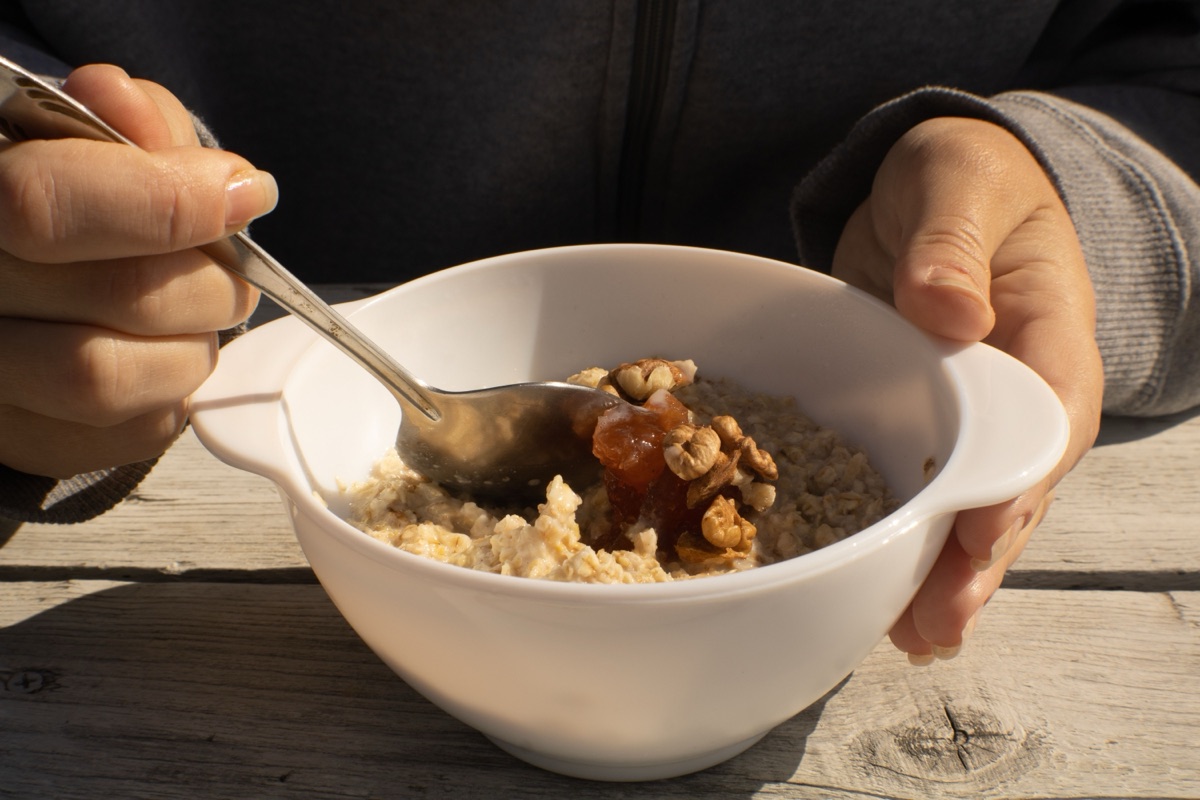
Change one piece every couple of days. By the end of the two weeks, the routine is in its autumn shape.
What not to do at the junction
- Do not start a hard fast. The tradition treats the handover as the weak point for digestion. Wrong week to test it.
- Do not overhaul everything at once. The point is steadiness. A brand-new routine with twelve practices is its own kind of disruption.
- Do not jump straight to heavy winter food. Rich stews and fried comfort food belong later, once the season has settled. At the seam, easy to digest comes first.
- Do not let the weekend move your clock. Sleeping in two hours on Saturday is exactly the irregularity the fixed times are there to stop.
- Do not ignore a change that stays. A wobble in appetite or sleep that settles as the season does is what this post is about. One that lasts more than a few weeks, or comes with weight loss, pain or anything that worries you, is a reason to see your doctor, not to try another routine.
The equinox is one evening. The junction is two weeks. Give it the two weeks.