
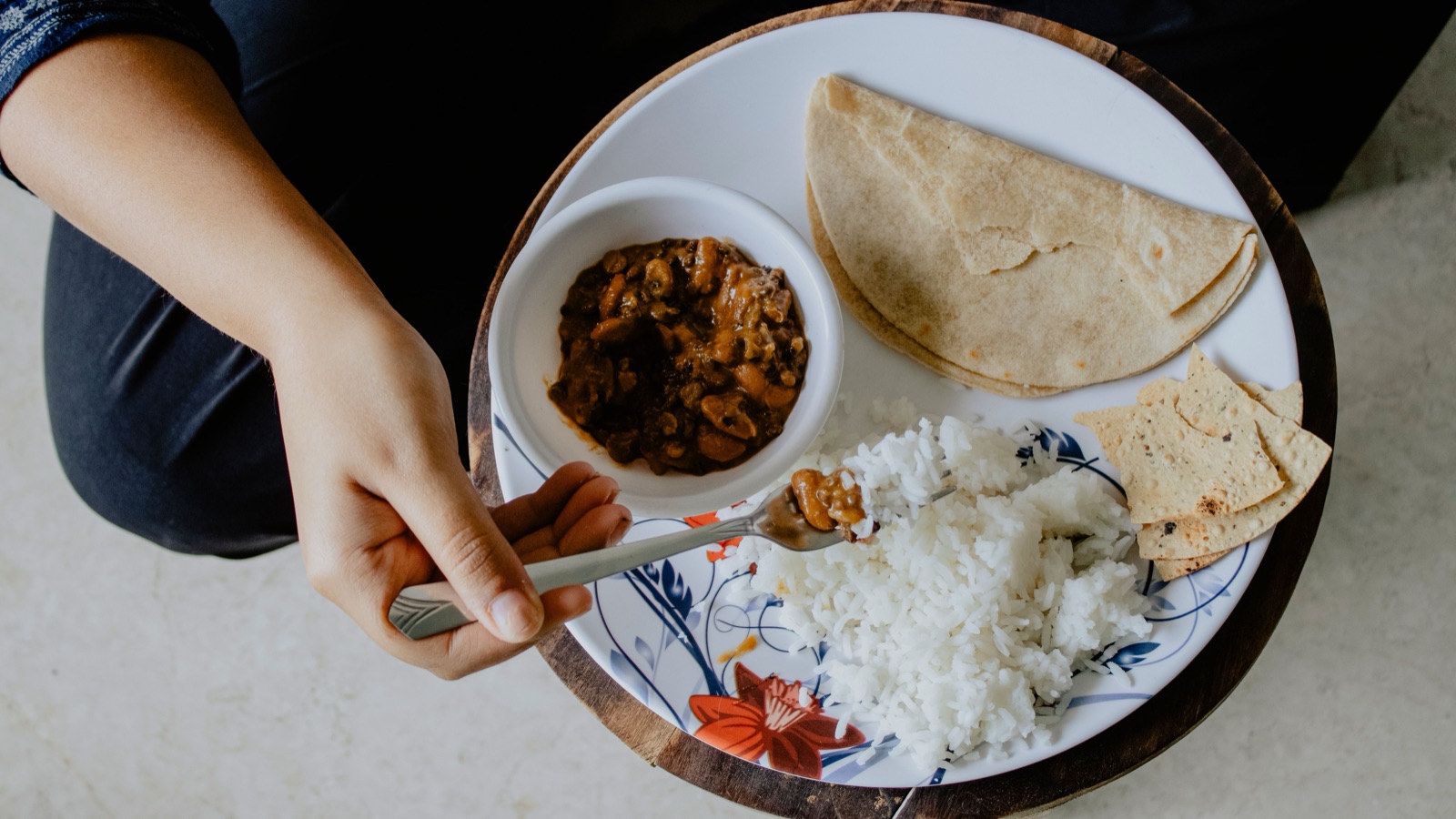
In healthy adults, most of a light test meal has left the stomach by two hours and nearly all of it by four. The whole trip from mouth to toilet usually takes more than a day, and most of that time is spent in the colon. Fattier meals and meals thickened with gel-forming fibre take longer, and the same person can measure differently from one test to the next. The food-by-food minute charts that circulate online, including the one this page used to carry, trace to no measurement we could find. The stomach empties meals, not single ingredients.
Why the food-by-food chart is gone
This page used to list foods with exact times: juice in 15 to 20 minutes, chicken in 1.5 to 2 hours, pork in 5. Charts like it are everywhere. We could not trace ours, or any of its cousins, to a measurement.
They also answer the wrong question. You rarely eat chicken alone on an empty stomach. Once a meal is mixed in the stomach, it leaves at a pace set by its fat, its calories, its texture and its size. What researchers can actually measure is how fast a whole meal leaves the stomach, and how long the remains take to leave the body. Here is what those measurements say.
What gastric emptying studies actually measure
The standard test is gastric emptying scintigraphy. You eat a meal containing a small amount of radioactive tracer, and a gamma camera records how much is still in your stomach over the next few hours. In 2008 the American Neurogastroenterology and Motility Society and the Society of Nuclear Medicine agreed on one version for clinics: a low-fat, egg-white meal, imaged at 0, 1, 2 and 4 hours.
The normal values for that meal come from 123 healthy volunteers, aged 19 to 73, tested at 11 centres. The median amount still in the stomach was 69% at one hour, 24% at two hours and 1.2% at four hours. More than 10% left at four hours counts as delayed emptying. Men emptied faster early on, but by four hours men and women were level.
Keep the limit in view. That is one standardised, low-fat meal. It tells you what a healthy stomach does with that meal, not what it does with a plate of lamb, potatoes and gravy.
Past the stomach, the timing gets looser. In 73 healthy volunteers who swallowed radiopaque markers, the colon alone took an average of 35 hours, and men moved the markers through faster than women. A later study used a swallowed wireless capsule in 215 healthy volunteers in the US and Sweden. Women had longer whole-gut transit than men by a median of about four hours, and other stretches of the gut shifted with age, country and the testing protocol. Whole-gut times clustered at intervals about 24 hours apart, which led the authors to conclude they should not be treated as a smooth, continuous measurement.
The number also moves within one person. When the same healthy volunteers were measured on two occasions, single results sometimes varied considerably, which the authors put down to broad biological variation. Transit is a range, not a reading.
What slows digestion down and what speeds it up
Liquid or solid. Solid food waits before it leaves. In 24 healthy volunteers given a labelled solid meal with labelled water, the solids showed a lag phase of about 31 minutes for egg and 62 minutes for denser chicken liver, which the authors attribute to the stomach breaking food into particles small enough to pass. After the lag, the solids emptied at the same rate as the liquid. The study did not test chewing, but our reading is simple: chewing is the part of that grinding you do yourself.
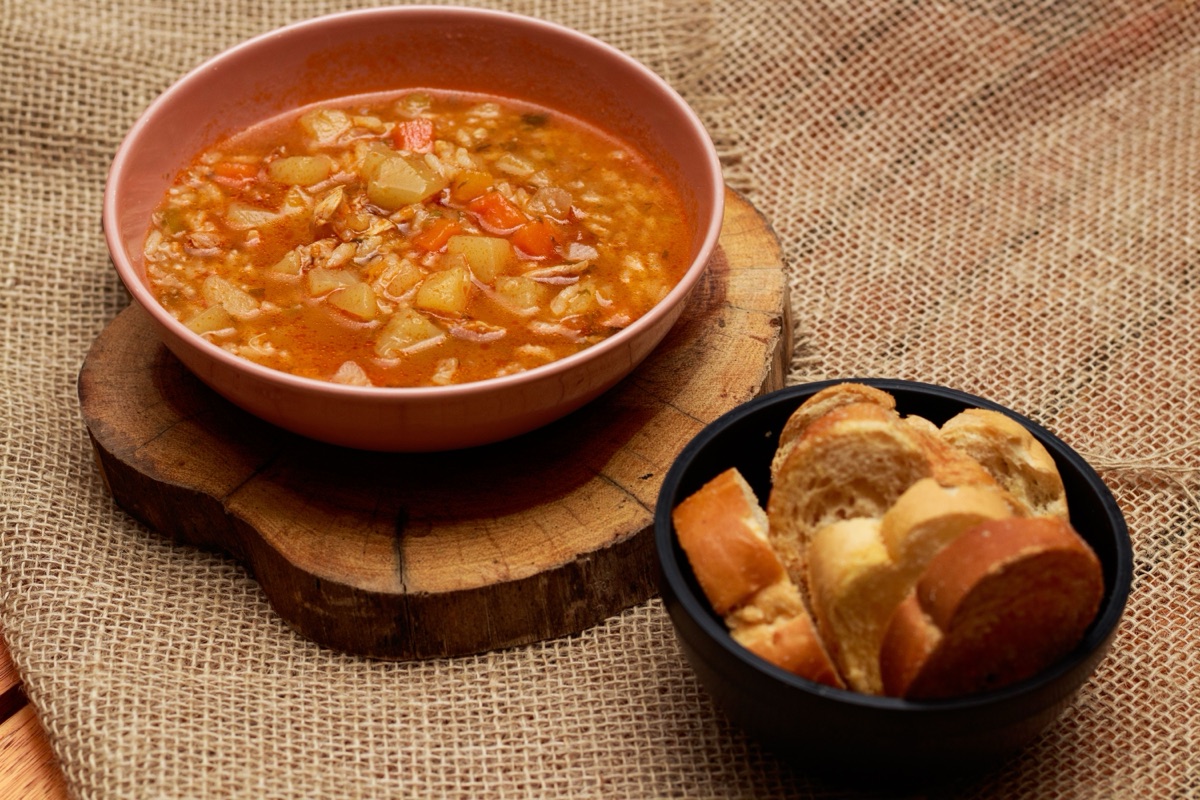
Fat and calories. Nine healthy volunteers ate lettuce-and-water meals with different amounts of salad oil added. More calories slowed how fast the solid food left the stomach, while the liquid part was unaffected. Bigger meals moved more grams per minute, so a large meal is not simply a slower one. In a separate study of eight healthy men, a high-fat meal took significantly longer to half-empty than a high-carbohydrate meal of the same energy. So "salad with oil" has no fixed time. In that study, the calories added as oil were what slowed it.
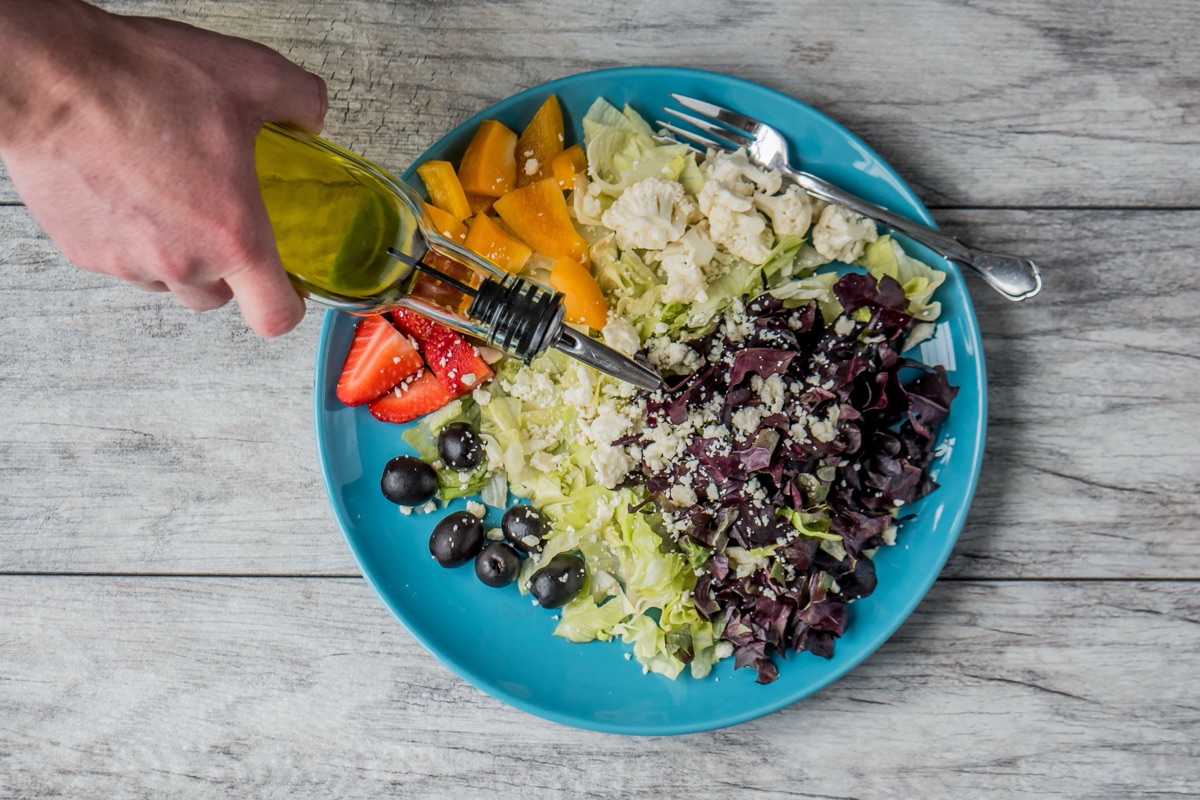
Fibre and thickness. Viscous fibres, the kind that thicken into a gel, can slow the stomach. When 15 healthy volunteers ate rice pudding thickened with locust bean gum, it emptied significantly more slowly, while thinning the same pudding with water made no difference. In 22 healthy young adults, an oat bread enriched with extra beta-glucan took 18 minutes longer to half-empty than a whole-wheat bread, mostly because emptying started later, and blood sugar and insulin rose less after it. That was a single test meal of a specially enriched bread, not a bowl of ordinary oats.
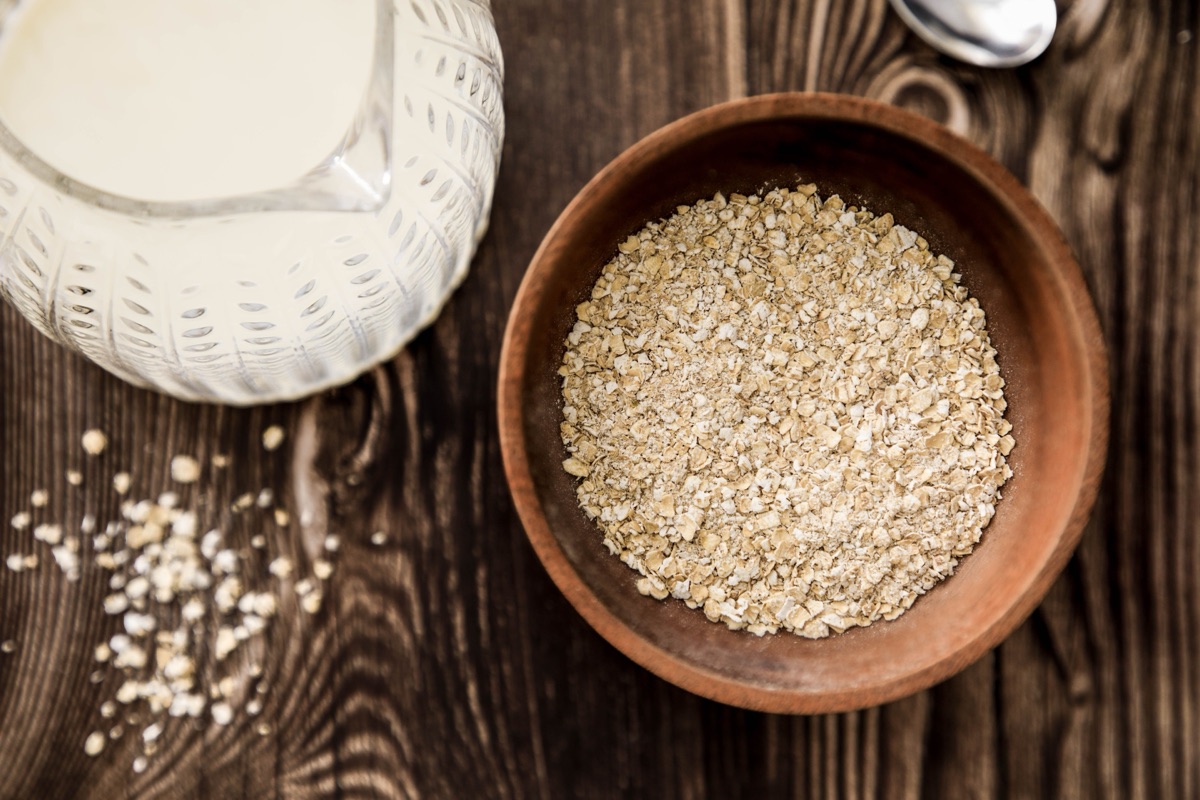
Who you are. Sex, age and body size all show up in the transit data, and not always in the same direction. In the 123-person study, older volunteers emptied the test meal faster. In a 2020 study of 111 healthy volunteers tracked with an electromagnetic capsule, older age went with longer whole-gut transit and a higher body mass index with shorter. A friend's timing tells you little about yours.
Does digestion speed affect weight loss?
The old version of this page said fast-digesting foods leave you hungry and that their unused glucose "turns into fat". That is too simple to keep. Here is what has actually been measured.
In 328 adults ranging from normal weight to obesity, obesity was associated with faster gastric emptying of both solids and liquids, along with differences in gut hormones after meals. That is an association in one group of people, not proof that fast emptying causes weight gain. And the 123-person study above found gastric emptying was independent of body mass index in its healthy volunteers. So even the association is not consistent between studies.
No study here tested the promise the old chart implied: that ordering your plate by digestion time changes your weight. We are not going to make it. What the measurements do support is narrower. Fat, viscous fibre, texture and meal size all change how food leaves your stomach, and researchers measure that alongside fullness for a reason. If weight is your concern, notice how long different meals actually keep you satisfied. That is information about your body. A chart is not.
The Ayurvedic view: agni and space between meals
Ayurveda asks the question from the other end. It cares less about how many minutes a food takes than about whether your digestive fire, agni, has finished the job.
The classical rule is plain. Among the methods of eating in the Charaka Samhita (Vimana Sthana 1.25) is jirne ashniyat: eat when the previous meal is digested. The reason the text gives is that new food mixed with partly digested food disturbs all three doshas. In the tradition's terms, that unfinished residue becomes ama, the heavy, sticky leftover of incomplete digestion.
Modern Ayurvedic practice, our own included, turns this into a few habits: no grazing, three to six hours between meals, and the largest meal at midday, when agni is said to burn strongest. The hour count is our working rule, not a number from the text. Our piece on making lunch the main meal covers why. The signal is not the clock. It is real hunger, and a body that feels light rather than still full from the last meal.
That three-to-six-hour habit overlaps the hours the stomach-emptying measurements above describe. The overlap is worth noticing and easy to overread. It is not a validation: the texts judged digestion by how people felt, not by gamma cameras.
The same rule matters more when the seasons turn and digestion gets irregular in autumn. For the whole picture, from agni and ama to the daily practices that support them, start with our guide to Ayurvedic gut health. Your dosha shapes which way your digestion tends to drift, and the dosha quiz is a quick way to find yours.
When a change in digestion needs a clinician
Digestion speed varies from day to day, and a slow afternoon after a heavy lunch is not a symptom. Some changes are different. See a doctor if you:
- notice a change in your poo, or in how often you go, that is not usual for you
- keep being sick, or see blood in your vomit
- see blood in your poo, which can look red or black
- are losing weight without trying
- have difficulty swallowing
- keep getting indigestion, or have severe pain
Ask for an urgent appointment if your poo is black or dark red, or you have bloody diarrhoea.
This page is general education, not medical advice. It does not replace a conversation with your own doctor, especially before you change how you eat if you have a medical condition or take medication.